


Individual conflicts may fade but deglobalization won’t
The Iran conflict was just one example of a broader shift that’s reshaping costs, trade and global priorities
Lectura de 5 minutos
PUNTOS CLAVE
- Deglobalization continues to reshape global trade, supply chains and economic priorities.
- Governments and businesses are focusing on supply-chain security and resilience over efficiency, leading to higher costs and increased domestic investment.
- As geopolitical tensions persist, consumers, companies and governments may face higher prices, more defense spending and long-term economic adjustments.
For much of the first half of 2026, one of the central questions shaping everything from gas prices to global tension was when the U.S. conflict with Iran would end.
On one hand, this focus was understandable. The economic fallout from the Iran conflict, particularly higher energy prices, underscored how deeply geopolitics is now tied to everyday affordability, noted BOK Financial® Chief Investment Officer Brian Henderson. Rising gasoline costs added pressure to household budgets at a time when many consumers were—and still are—struggling to make progress on the cost of living.
On the other hand, focusing too narrowly on any single conflict risks overlooking the bigger picture, Henderson and other BOK Financial experts cautioned. One conflict ending-or, at least, tensions subsiding-doesn't mean a reversal of the ongoing increased geopolitical tension that's characteristic of deglobalization.
como director de inversiones de BOK Financial Steve Wyett explained, "There are things that accelerate it or slow it, but overall deglobalization is continuing. It's not just the war in Iran. It's all the tariff policies and the continuing divide between the Eastern Hemisphere and the Western Hemisphere."
A reversal of a 30-year trend
Deglobalization is the gradual unraveling of globalization, the movement towards greater cooperation and trust between countries that persisted for 30 years after the fall of the Berlin Wall in 1989. This cooperation and trust created a more efficient global economy, resulting in lower prices on goods, lower U.S. interest rates and higher stock multiples-in sum, creating a "peace dividend," said Matt Stephani, presidente de Cavanal Hill Investment Management, Inc., una subsidiaria de BOK Financial Corporation.
Cracks in that system didn't emerge overnight-and they won't resolve quickly either, experts cautioned. Instead, a combination of geopolitical tensions, supply-chain disruptions and policy shifts has exposed vulnerabilities in it. Events like the Covid pandemic, the war in Ukraine and the Iran conflict have demonstrated how easily access to critical goods-such as energy, semiconductors and pharmaceuticals-can be disrupted. When those disruptions occur, as they did during the pandemic, the economic consequences ripple quickly across industries and households alike.
From efficiency to security
As a result, countries and corporations are rethinking what they prioritize in supply chains. In the more cooperative global economy of the past, lower cost was the focus; now, it's reliability and security. This new focus is encouraging countries and corporations to onshore or friend-shore critical materials such as semiconductors, pharmaceuticals, rare-earth minerals and other commodities, Stephani noted.
“Every single country that relies on another country for important products is reevaluating who their partners are,” he said.
The cost of resilience
For consumers, the most visible impact of this reevaluation will be in prices. Globalization was a "huge disinflationary force" because it allowed companies to seek out the lowest-cost labor and production globally, Wyett said.
Now, some of those disinflationary benefits are fading, which is playing out directly in consumer prices. Higher costs tied to supply-chain restructuring, combined with geopolitical disruptions like the Iran conflict, can push prices higher-especially for energy and goods that rely on global transportation networks, Henderson said.
While this restructuring can help prevent shortages, it also means that prices may remain more volatile and persistent than in the past, which could continue to present problems for the Federal Reserve's goal of achieving 2% inflation, Wyett said. In his words: "Resilience might come at a little bit of a price."
Rising defense spending and fiscal pressure
World leaders are also adapting to this new environment, and that adaptation is coming with its own costs. Wyett noted that countries like Saudi Arabia are looking at different ways of transporting oil that don't include going through the Strait of Hormuz. "That will take some time and increase some costs," he said. However, these alternate routes also could help avoid the price pressures on oil that occurred during the U.S.-Iran conflict this year, when the closure of the strait put an estimated 20 million barrels per day of oil at risk.
Meanwhile, the increased geopolitical activity, both in the Middle East and beyond, is already driving higher defense spending, Henderson noted. In the U.S., defense spending has risen to around $1.17 trillion annually, as of the first quarter of 2026, compared to $626 billion 10 years ago, according to figures from the Federal Reserve Bank of St. Louis.
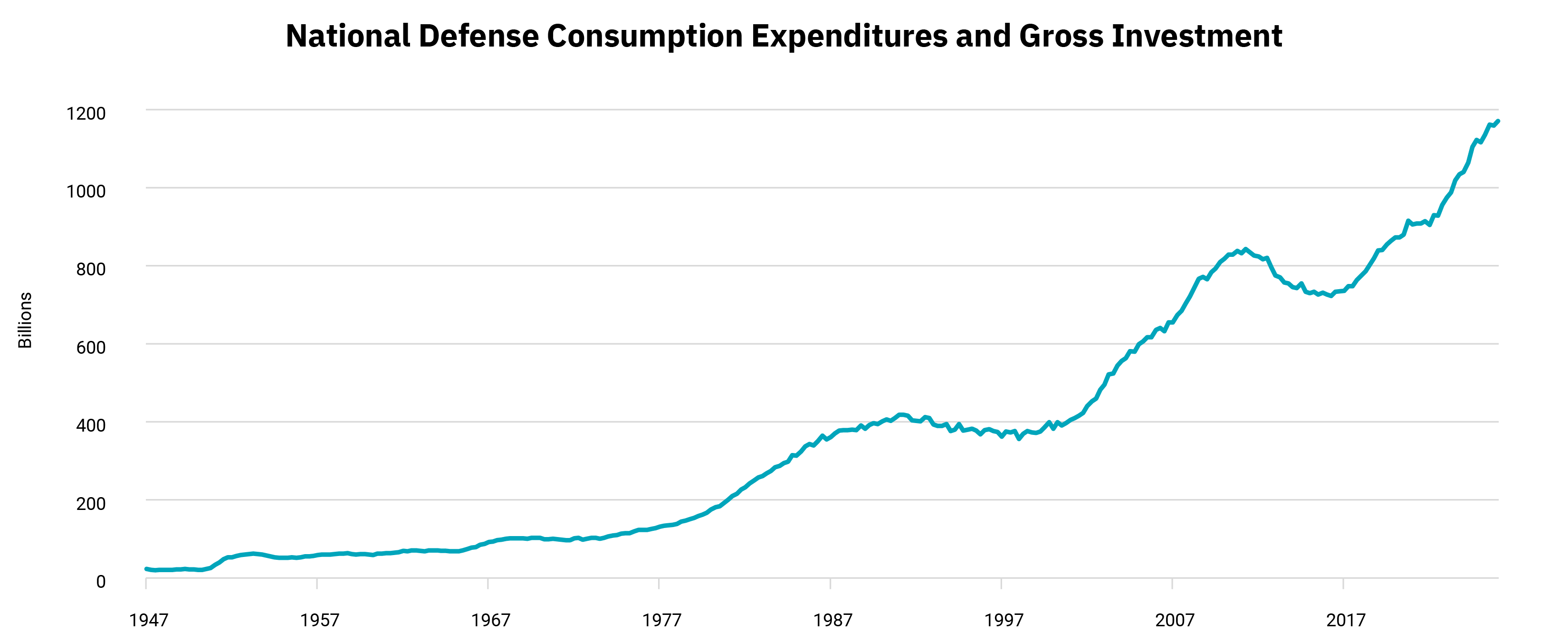
Source: U.S. Bureau of Economic Analysis via FRED®
That trend has important fiscal implications because it could widen the federal deficit or force tradeoffs in other areas of government spending. Moreover, because the underlying geopolitical tensions likely will persist-at least in the foreseeable future-so will these pressures on government spending.
At the same time, governments and corporations are also investing in domestic production-especially in areas like manufacturing, energy and technology-to reduce reliance on foreign supply chains. For example, the current U.S. tariff policies are encouraging global manufacturers to build factories in the United States rather than exporting goods into it, Wyett said. He pointed to automakers and pharmaceutical companies expanding U.S.-based production to avoid tariffs, reflecting a broader push to reduce reliance on overseas manufacturing.
A longer timeline than many expect
While individual conflicts can capture headlines, the larger shift toward a more fragmented global economy is likely to unfold over decades. During this time, these hallmarks of deglobalization, like choosing secure supply chains over less expensive ones, are likely to continue.
However, eventually, the world economy may move back towards globalization again. In Stephani's words: "It's a pendulum. You swing it one way and it carries momentum until it reaches an apex, and then it starts coming back."
Read more of our Actualización del mercado a mitad del año 2026.